
Navigating Cancer Treatment When the Plan Changes
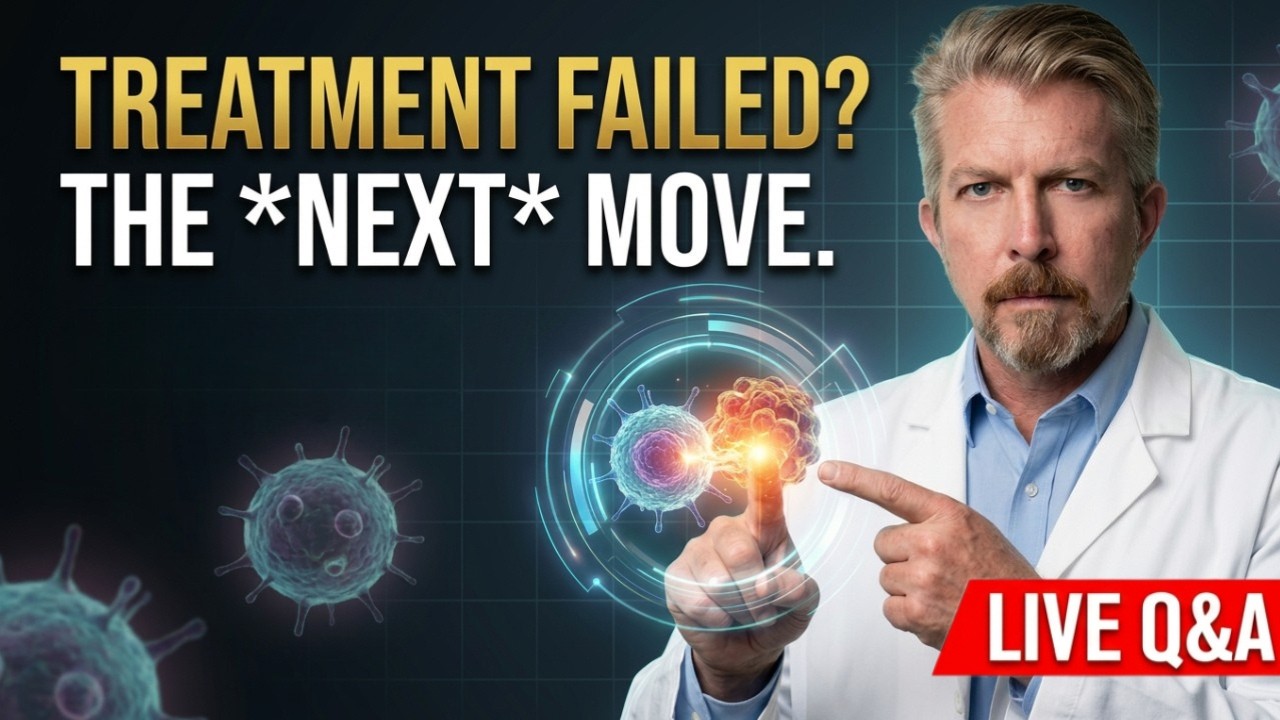
If you're a cancer patient who's been told your treatment isn't working, the first thing to understand is that "treatment failure" isn't one thing. It's at least three very different situations — and which one you're in changes everything about what comes next. In this live Q&A, Cancer Drug Designer Dr. Chaplin broke down drug resistance, chemotherapy side effects, cancer recurrence, and what oncologists often don't explain about switching drugs.
Three Reasons Chemotherapy Stops Working
Treatment failure in oncology falls into three categories. First, intolerable side effects — the drug may be working, but your body can't sustain it. Second, containment without progress — your cancer isn't growing, but it isn't shrinking either, and insurance may eventually pull the plug on an expensive drug that's "only" holding the line. Third, true cancer progression — tumors are growing despite treatment. That's actual drug resistance.
Each requires a completely different response. Collapsing them all into "the treatment failed" is where cancer patients get lost.
How to Manage Chemotherapy Side Effects Without Stopping Treatment
For classic chemotherapy, side effects that feel unbearable are often manageable with assistance. Apigenin helps mitigate toxicity from platinum drugs, doxorubicin, and 5-FU. Glutamine at higher doses — 30 to 40 grams around infusion days — protects the GI tract during regimens like FOLFOX and FOLFIRI. For immunotherapy, high-dose vitamin D, curcumin, or resveratrol taken around the infusion window can dampen immune-related adverse events before they spiral.
For chemo side effects that fall short of a true immune crisis, pausing and restarting with support is often possible, or try either adjusting timing or metronomic dosing. For severe immunotherapy reactions, stopping may be necessary — but careful reintroduction often works.
What PD-L1, Drug Efflux Pumps, and Targeted Therapy Have in Common
When cancer treatment is containing the disease but no longer improving it, true drug resistance may not be the issue. The more likely culprit is P-glycoprotein (or P-gp) — a protein on cell membranes that pumps out foreign substances, including chemotherapy. Cancer cells get better at expelling the drug before it can do its job.
P-gp can be partially blocked. Verapamil is a prescription option your oncologist should know about. High-dose CoQ10, curcumin, apigenin, and resveratrol also compete for P-gp binding and can re-sensitize tumors to targeted therapy and chemotherapy drugs that are still partially working. The tradeoff is real — blocking P-gp increases drug potency throughout the entire body, so side effects go up too. This is a personalized conversation, not a blanket recommendation.
Drug Resistance and the Switch That Won't Work
If your cancer has developed true resistance and is progressing, switching to a similar drug in the same class is not a solution. Docetaxel to Abraxane is the same drug in a different delivery system. If you're resistant to 5-FU, capecitabine — which converts to 5-FU in your body — probably won't help either. The same logic applies across microtubule inhibitors, platinum drugs, and kinase inhibitors in the same family.
The best move is a different drug class entirely. And even a two-to-three month break can allow the cancer's genetic landscape to shift enough that the original drug regains some efficacy. Cancers are constantly evolving — that works against you, but it can also work for you as well.
Supplement Q&A: Glutamine, Apigenin, Vitamin K2, and Pectasol
The live Q&A covered a lot of ground on supplements for cancer patients.
Glutamine at 10 grams daily supports general tissue health and reduces wasting. Around infusion days for FOLFOX, FOLFIRI, or CAPOX, bump that to 30 to 40 grams. Glutamine is not the same as glutathione — and during platinum-based chemotherapy, high-dose glutathione and N-acetyl cysteine are not recommended.
Apigenin came up repeatedly — for blocking chemo side effects, for re-sensitizing resistant tumors, and for immunomodulation alongside checkpoint inhibitors. Tecan-class drugs including ADCs like Enhertu and Datroway are best dosed in the late afternoon. Alkylating agents and 5-FU family drugs are early morning. Timing matters.
Vitamin K2 at high doses builds up in cell membranes rather than staying in the bloodstream. Minimum three days to reach effective levels, maximum 14 days before a break. It works across most cancer types with exceptions for GBM, astrocytoma, and gallbladder cancers.
Modified citrus pectin has real clinical data for colorectal cancer and metastasis prevention — but the required dose is 45 grams per day. At that level, a roughly 9% reduction in metastases is meaningful but there may be more practical options depending on your situation.
What's Next for Cancer Drug Development
Dr. Chaplin opened the session with news from ASCO — Revolution Medicine's daraxonrasib is generating major attention for its impact on the KRAS pathway, which drives roughly 25% of all cancers including pancreatic cancer. Resistance is already emerging in clinical trials, which made it a natural entry point for the evening's topic.
The next live on June 15 covers immunotherapy — what makes it work better, biomarkers including PD-L1, and what most oncologists skip. July 6 covers how to evaluate health claims and the science behind ivermectin, fenbendazole, and the biggest cancer myths.
If anything from this session applies to your treatment — book a free intro call through the link in the YouTube comments.
Accurate science saves lives — and it starts with rejecting simple myths in favor of real understanding. Stay curious.
Disclaimer: This content is for educational purposes only and is not medical advice. It does not replace guidance from your healthcare provider. Cancer and treatment decisions are highly individual—always consult your physician or qualified healthcare professional regarding your specific situation.
A full disclaimer is available Terms and Conditions.