

The Cancer Myth Hiding Inside a Good Word
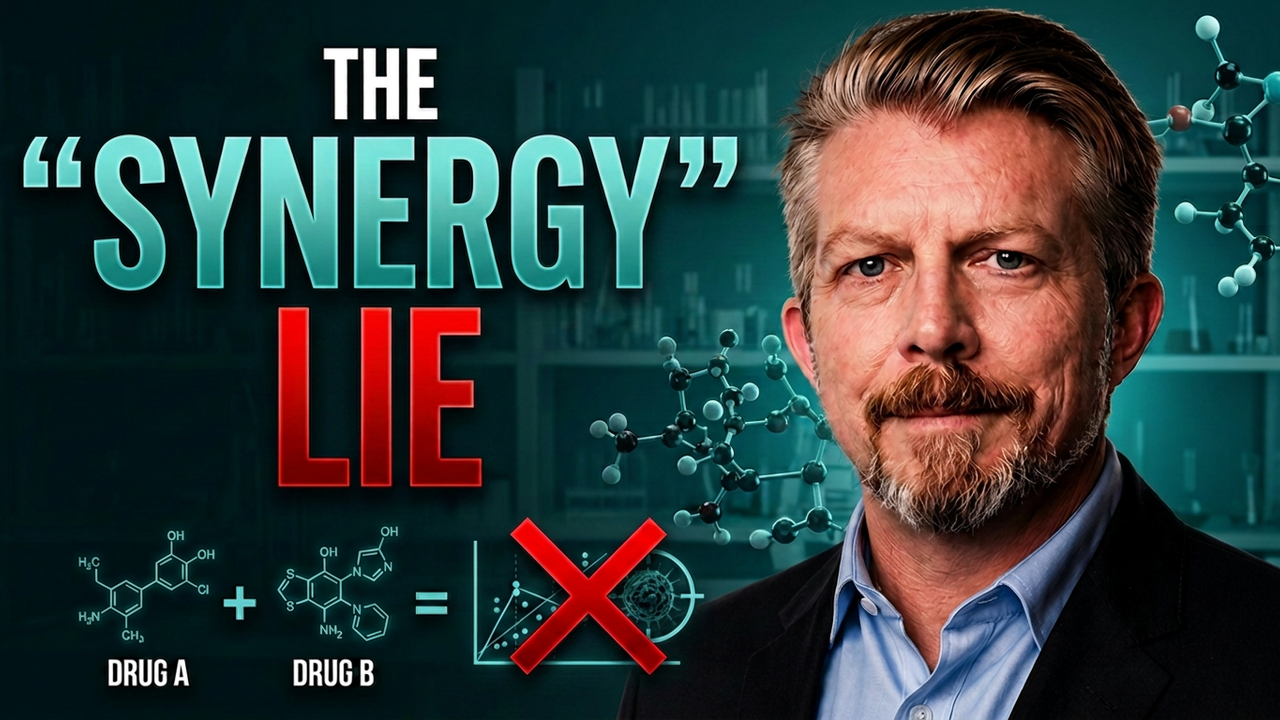
There's a word floating around cancer treatment circles that deserves more scrutiny than it gets: synergy. It's become one of the most common cancer myths in alternative and off-label protocols — used to describe supplement stacks and drug pairings like ivermectin and fenbendazole cancer claims — but real synergy isn't a feeling or a hope. It's basic math, with a name, a formula, and a number attached to it. In this episode, Dr. Jay Chaplin breaks down exactly how researchers prove synergy exists, and why so many popular cancer treatment claims fall apart the moment you run the numbers.
What Synergy Actually Means in Cancer Treatment
Real synergy has a formal name: the Chou-Talalay Combination Index. Two researchers built a mathematically rigorous framework for testing whether two drugs actually amplify each other's effects. Test Drug A alone, test Drug B alone, test them together, then compare. The result is a single number, the Combination Index, or CI. A CI of exactly 1 means additivity. A CI below 1 means antagonism — the drugs work against each other. A CI above 1 is genuine synergy — the combination outperforms what either drug would do alone.
Why the Ivermectin Cancer and Fenbendazole Cancer Combo Fails the Test
Here's the rule: if a compound doesn't show a real, measurable effect on its own at the dose being used, it cannot have synergy with anything. Zero plus X is unchanged, still X. This is exactly why the popular ivermectin-and-fenbendazole "synergy" claim collapses — neither drug shows meaningful independent anti-cancer activity at human-safe doses, so no calculation can turn two non-effects into a powerful combined one.
Antagonism and Immunotherapy: Synergy's Overlooked Opposite
Just as important as synergy is antagonism — where combining treatments makes outcomes worse. One clinical example: immunotherapy checkpoint inhibitors paired with steroids or immunosuppressive supplements can actively undercut the immune activation the immunotherapy is trying to achieve. Antagonism doesn't make for good marketing, so almost no one talks about it — but it's why "just add more" is risky.
Three Real Synergy Combinations Changing Breast Cancer and Melanoma Treatment
The episode closes with three documented synergy examples: BRAF and MEK inhibitor combinations in melanoma, dual HER2 blockade in breast cancer, and PARP inhibitors paired with immunotherapy. In every case, both components had independently measurable activity before combination — and the Combination Index confirmed real, reproducible amplification.
Before accepting any synergy claim about your cancer treatment: where's the number?
Accurate science saves lives — and it starts with rejecting simple myths in favor of real understanding. Stay curious.
Disclaimer: This content is for educational purposes only and is not medical advice. It does not replace guidance from your healthcare provider. Cancer and treatment decisions are highly individual—always consult your physician or qualified healthcare professional regarding your specific situation.
A full disclaimer is available Terms and Conditions.