
How to Make Immunotherapy Work Better for You — A Cancer Drug Designer's Step-by-Step Protocol
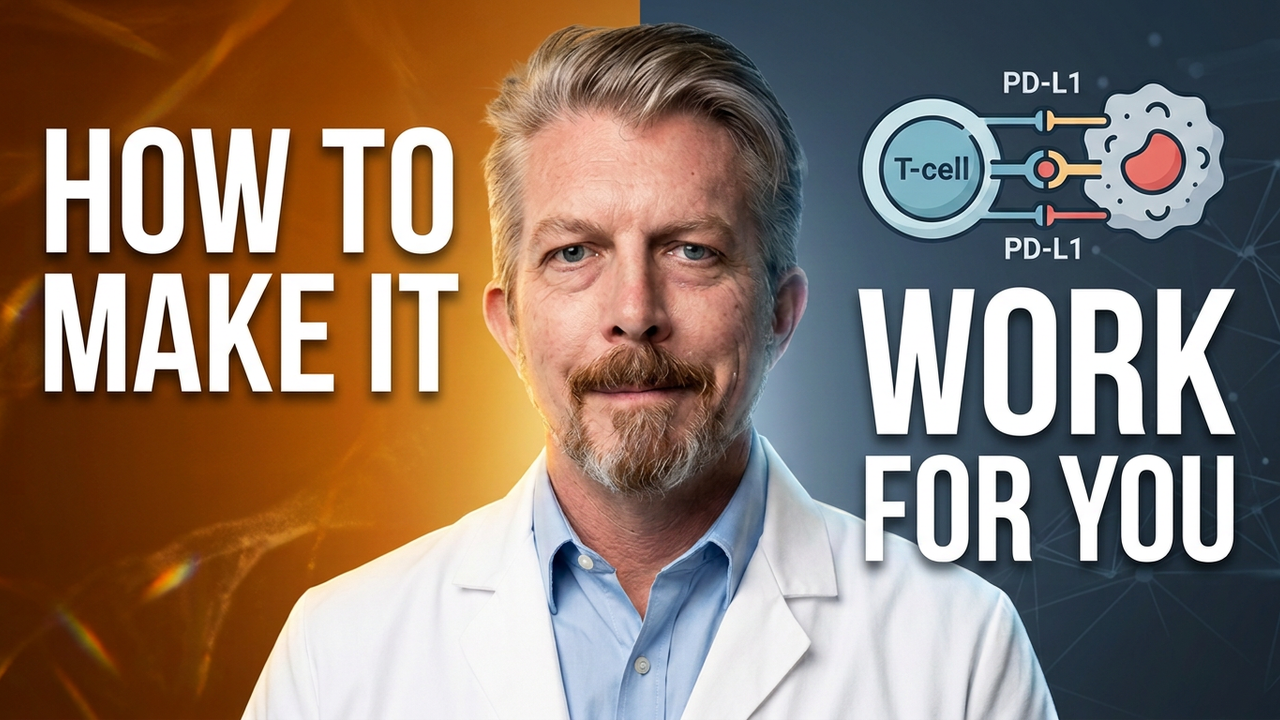
If you are a cancer patient on immunotherapy — whether that's Keytruda, Opdivo, or another immune checkpoint inhibitor — the difference between a strong response and a failed one often comes down to decisions your oncologist never discusses with you. In this live Q&A, Cancer Drug Designer Dr. Jay Chaplin broke down the cancer immunology behind how natural killer cells and killer T-cells work, why dexamethasone quietly undercuts your treatment, how to safely boost PDL1 checkpoint response step by step, and what supplements like apigenin, AHCC, turkey tail, chaga, and vitamin K2 actually do — across breast cancer, lung cancer, colorectal cancer, lymphoma, leukemia, pancreatic cancer, and prostate cancer. This is the immunotherapy science explained that most oncologists skip entirely.
The Biggest Danger With Immunotherapy Isn't Failure — It's Overdoing It
The goal of cancer immunotherapy is to get your immune system to attack the cancer powerfully, completely, and leave lasting surveillance behind. That outcome is achievable in a meaningful fraction of patients. But the fastest way to lose access to immunotherapy permanently is to overactivate your immune system and trigger a serious immune-related adverse event — liver damage, kidney damage, severe colitis, thyroid destruction.
Once that happens, you come off immunotherapy, shut down your immune response with steroids, and typically cannot go back on treatment. That is why the step-by-step approach matters. You want your immune system as activated as possible without crossing into dangerous territory. That line is different for every person, which is why you add things in one at a time and monitor each cycle before adding the next.
Why Dexamethasone Is Quietly Costing You Half Your Immunotherapy Efficacy
Most oncologists automatically give dexamethasone with immunotherapy infusions to protect against immune overreaction. The intention is good. The execution is the problem.
Dexamethasone has a long immunosuppressive tail — a single dose continues to suppress immune function for up to a week and a half. On a three-week Keytruda cycle, that means you are losing roughly half the efficacy window of your treatment to steroid suppression.
The alternative is short-acting immunosuppressants taken only the day before and day of infusion. High-dose vitamin D3 above 10,000 IU, curcumin at six or more grams, resveratrol, and black seed oil all suppress immune function for roughly 24 hours — enough to protect you during the danger window without that week-long tail. After your first clean infusion, go back to your oncologist and ask for a step-down dose reduction on the dexamethasone. Rinse and repeat until it's out entirely, if possible.
The Step-by-Step Protocol for Boosting Natural Killer Cells and Killer T-Cells
This is the protocol Dr. Chaplin walks his clients through. Each step is added one cycle at a time so you can identify any immune reaction before adding the next layer.
Step one: 81mg aspirin in the morning and 200mg apigenin in the evening. Both block thromboxane A2 through slightly different mechanisms, which mildly releases the brakes on natural killer cells and killer T-cells. This is the safest starting point and appropriate to take continuously throughout all cycles.
Step two: Add AHCC — active hexose correlated compound, an alpha glucan from shiitake mushrooms. AHCC specifically stimulates natural killer cell numbers and function. Natural killer cells are critical for cancers that have downregulated the recognition systems killer T-cells depend on, which includes most metastatic and long-standing cancers, as well as virally driven cancers like HPV and HBV. Do not take AHCC the day before or day of infusion — resume the morning after.
Step three: Add turkey tail mushroom. This one increases the number of killer T-cells rather than natural killer cells — a different and complementary mechanism. Same timing rules apply: skip infusion day and the day before.
Step four: Add chaga. Chaga increases the functional activity of killer T-cells — it makes them more responsive once you've already increased their numbers with turkey tail. Together these three mushroom supplements cover both branches of cellular immunity in a layered way.
Step five — the most powerful and the last: if you have any tumor within a quarter inch of the skin surface, imiquimod cream applied to that spot triggers a local immune response that can generate an abscopal effect, where treating one tumor causes your immune system to attack tumors elsewhere in the body. This one has the most potential and the most risk, which is precisely why it goes last.
Cancer Immunology Notes — Drug Interactions That Matter
Not all drug combinations that look good on paper work in practice. Lenvatinib and Keytruda genuinely work better together — each blocks the resistance mechanism the cancer develops against the other. That combination has solid data.
CDK4/6 inhibitors like palbociclib combined with immunotherapy initially looked very promising — they do increase immune function and reduce immunosuppressive activity at the tumor microenvironment. But both clinical trials combining them long-term had to be stopped early when nearly all participants developed severe immune-mediated liver destruction. Short-term pulsing — one week of palbociclib alongside an immunotherapy cycle — appears safer, but this is a conversation that requires individual context.
Gemcitabine given on the same day as immunotherapy actively damages stimulated immune cells, which are among the fastest-replicating cells in the body and therefore the most vulnerable to chemotherapy. Cisplatin is better for immunogenicity but still needs to be sequenced — ideally a week before the immunotherapy infusion rather than the same day. Apigenin and glutamine help offset some of that damage but do not eliminate it.
Supplement Q&A Highlights
Mushroom supplements — AHCC, turkey tail, chaga — do not enter your bloodstream. They interact entirely at the gut lining, where 70% of all immune cells in your body are located. This also means the liver enzyme interactions sometimes cited for AHCC are theoretical only — based on cell culture studies using AHCC applied directly to cells in a dish, not oral supplementation in a normal human body. No real-world concern.
For mushroom dosing: whatever the bottle says, double it. Across every brand and every type, the label dose consistently appears to be about half of what produces a therapeutic effect.
Vitamin K2 dosing for active cancer: 115mg per day minimum for 3 to 14 days, then a 14-day break. Breast cancer requires approximately double — around 220–230mg. Does not work for glioblastomas, astrocytomas, or bile duct and gallbladder cancers. For maintenance and prevention, three days at 115mg once every couple of months.
Curcumin and resveratrol shut down NF-kappa B in lymphocytes — this is well established basic cancer immunology. We are aware that Grok says otherwise, but AI is frequently wrong and is definitely off the mark in this case. If you are on any immune checkpoint inhibitor, do not take therapeutic doses of curcumin, resveratrol, or black seed oil during your active treatment cycle. You cannot get the benefit of both simultaneously.
Accurate science saves lives — and it starts with rejecting simple myths in favor of real understanding. Stay curious.
Disclaimer: This content is for educational purposes only and is not medical advice. It does not replace guidance from your healthcare provider. Cancer and treatment decisions are highly individual—always consult your physician or qualified healthcare professional regarding your specific situation.
A full disclaimer is available Terms and Conditions.