

Is Insulin Potentiation Therapy Helping or Hurting You? What the Clinical Trial Data Actually Shows
If you are exploring alternative cancer treatments or looking for ways to avoid standard chemotherapy, you have probably encountered insulin potentiation therapy — or IPT. Integrative medicine clinics and functional medicine providers market it as a cutting-edge, low dose chemotherapy approach with fewer side effects and the same or better results. It sounds compelling. But IPT was developed in 1930, before penicillin was in clinical use. And when you actually read the clinical trial data — not just the abstracts — a very different picture emerges. Here is what the biology and the published evidence actually show.
The Original Theory and Why the Biology Doesn't Support It
The core idea behind IPT is that insulin makes cancer cells more porous and receptive to chemotherapy. Cancer cells are greedy for sugar — that much is real. They overexpress a glucose transporter called GLUT1 that allows them to absorb glucose at higher rates than normal cells. The updated version of IPT, offered by clinics including Envita Medical Center, involves bringing a patient to a near-hypoglycemic state with insulin and then infusing a mixture of chemotherapy and glucose — a so-called Trojan horse method.
The problem is structural. GLUT1 moves individual glucose molecules one at a time. It cannot transport disaccharides. It cannot transport chemotherapy drugs — not attached to glucose, not mixed with glucose, not in any configuration. The drug and the sugar are simply mixed together, not linked. This is not a hypothesis or an interpretation. It is basic molecular biology. A chemotherapy molecule cannot fit through a glucose transporter any more than a king size mattress fits through a Mini Cooper door.
What the Published Clinical Trials Actually Show
There have been two published IPT trials. The data, when read carefully, is not just underwhelming — it raises serious concerns.
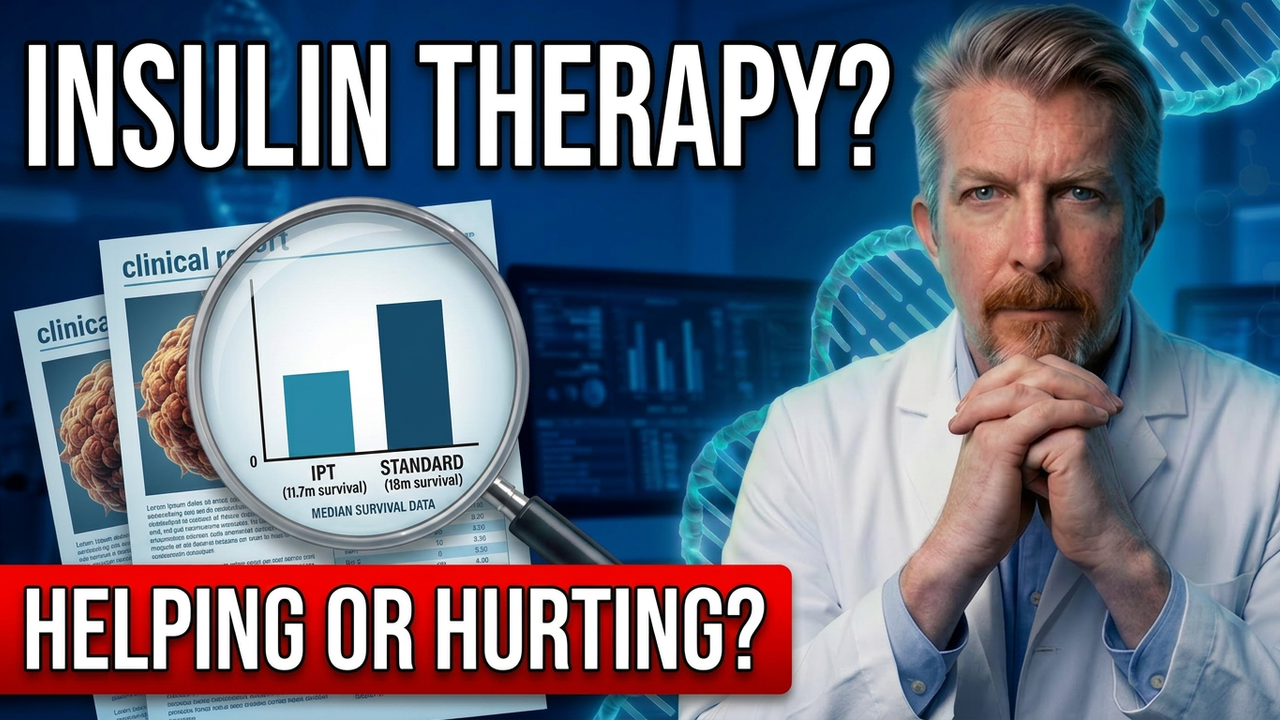
The Gavrilov 2012 paper on prostate cancer calls its results very promising and reports an 11.7 month median survival. The standard of care for the same patient population produces 18 months. Eleven point seven is not very promising. It is substantially worse.
The no side effects claim in that same paper is equally problematic. Five of the 16 patients required blood transfusions — by definition a grade 3 or grade 4 adverse event. That is a major side effect by any clinical standard. And seven of the 16 patients dropped out of the trial because they could no longer afford the treatment. Patients in a clinical trial should not be paying for the experimental intervention. That raises serious ethical questions about who this trial was designed to serve.
Even the CAM Cancer Organization — a group explicitly dedicated to promoting complementary and alternative medicine — cannot find sufficient evidence to endorse IPT and highlights these same problems. When an organization that wants something to work cannot make the case for it, that is worth paying attention to.
Practical Takeaway: What to Ask Before You Say Yes
If IPT is being offered to you, ask to see the clinical trial data — not the abstract, the full paper. Ask what the survival outcomes were compared to standard of care. Ask why patients in the trial were paying for an experimental treatment. The answers to those questions will tell you what you need to know. Getting a second opinion before committing to any modified dosing protocol is always worth the time.
Accurate science saves lives — and it starts with rejecting simple myths in favor of real understanding. Stay curious.
Disclaimer: This content is for educational purposes only and is not medical advice. It does not replace guidance from your healthcare provider. Cancer and treatment decisions are highly individual—always consult your physician or qualified healthcare professional regarding your specific situation.
A full disclaimer is available Terms and Conditions.